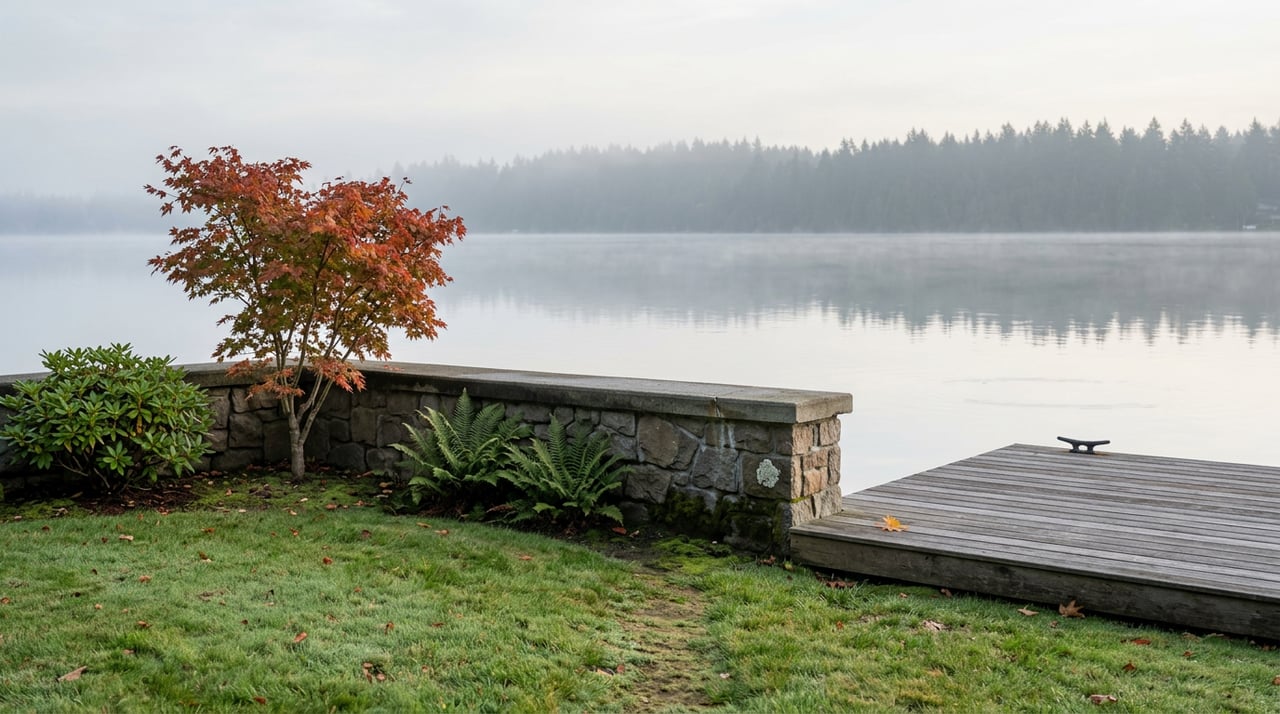
What Slows a Kirkland Waterfront Home Closing?
August 20, 2026
August 20, 2026
Kirkland's overall housing market spent the first half of 2026 loosening its grip. Homes that used to go pending in six days now take thirteen. Sale counts are down. Median prices, measured across the whole city, dipped compared to a year earlier. If you've been reading the general market coverage, the story sounds like relief: more time to think, more room to negotiate, a seller's market finally exhaling.
Walk down to the water and that story stops applying.
In the first quarter of 2026, well-positioned homes in Houghton and Juanita sold at a median of 104 percent of list price, according to NWMLS data. Buyers who didn't escalate lost. That is not a cooling market. That is a market that split in two, and most of the coverage only describes the half that isn't on the lake.
Kirkland's citywide price figures blend a lot of very different housing. A Totem Lake townhome and a Houghton lakefront estate get averaged into the same headline number, and the headline number tells you almost nothing useful about either one.
Break it apart by neighborhood and the picture gets sharper. Houghton and Moss Bay waterfront properties are trading in the $2 million to $15 million-plus range. Juanita and Rose Hill, a step back from direct lake access, typically run $900,000 to $2 million. Finn Hill and Totem Lake, further from the shoreline, offer entry points closer to $800,000 to $1.5 million.
| Area | Typical price range | Water relationship |
|---|---|---|
| Houghton, Moss Bay | $2M–$15M+ | Direct waterfront, private dock potential |
| Juanita, Rose Hill | $900K–$2M | Near-water, walkable to lake parks |
| Finn Hill, Totem Lake | $800K–$1.5M | Inland, commute-driven demand |
That spread explains why a citywide "median sale price" is close to useless for someone actually shopping the water's edge. Over the three months ending May 2026, the city's median sale price sat around $1.3 million, down from the year before. That figure is being pulled down by everything happening in the inland tiers. It says nothing about whether you can win a Houghton listing without escalating past asking.
For a buyer or seller working the shoreline specifically, the citywide softening is real but it belongs to a different submarket. The water hasn't cooled at the same rate, and pricing a waterfront listing or writing an offer as if it had is the first mistake.
Escalation clauses are standard practice on Kirkland waterfront right now, not a fallback. For homes priced in the $1 million to $2 million range, a starting escalation cap of $50,000 to $100,000 above list is a reasonable floor, adjusted from there based on comparable sales for the specific property. Earnest money on competitive Houghton and downtown offers tends to run 1 to 3 percent of purchase price, sometimes higher when multiple offers are already on the table.
None of that is unusual advice for a hot submarket. What's different about waterfront Kirkland is what happens after you get to contract. Winning the offer is the easy part. The friction that actually slows a closing shows up in the weeks after, once inspection and permitting questions start surfacing.
A waterfront home in Kirkland almost never involves just one regulator. Any work on a dock, bulkhead, or shoreline structure typically touches three separate authorities: the City of Kirkland's own Shoreline Master Program, the Washington Department of Fish and Wildlife through a Hydraulic Project Approval, and in many cases the U.S. Army Corps of Engineers, which issues a Regional General Permit for qualifying dock and overwater structures. Buyers who assume a dock repair is a single trip to city hall find out otherwise fast.
Washington law does carve out one piece of relief. Since August 2023, replacing an existing residential dock is exempt from a full Shoreline Substantial Development Permit as long as the fair market value of the work stays under $28,000 and the new structure is the same size or smaller than what it replaces. Below that threshold, the process moves faster. Above it, or if the footprint grows, the full permit track applies, and that track runs through the Department of Ecology's shoreline permitting process, which sits on top of whatever Kirkland's own Shoreline Master Program already requires.
Bulkheads are the more expensive surprise. Replacing a failing bulkhead typically runs $500 to $1,500 per linear foot. A property with 75 feet of shoreline, which is not an unusual lot width along Lake Washington, could be looking at $37,500 to $112,500 in bulkhead work alone, before any dock is touched. That range should be part of the inspection conversation on any waterfront purchase, not a line item that surfaces after closing.
As KOMO News reported, a Kirkland homeowner named Pamela Bendich described a bulkhead that had sealed off her yard from the water's edge and was causing sinkholes in her lawn. She worked with Washington Sea Grant's Green Shores for Homes program, which helps property owners consider softer shoreline alternatives and navigate the permitting process for that kind of project, and the city was reported at the time to be the first in the state to partner formally with the program. Whether a given fee waiver or fast-track arrangement is still in effect today is worth confirming directly with the city's planning department, but the underlying lesson holds regardless: bulkhead problems are rarely a one-line fix, and the permitting path depends heavily on what you're replacing it with.
Kirkland's Zoning Code Chapter 83 is the document that actually governs all of this locally, and it's worth a buyer's agent pulling the relevant sections before writing an offer on anything with lake frontage, not after.
Not everyone drawn to Kirkland's waterfront wants a bulkhead to think about. A downtown or Moss Bay condo gets you walkable lake access without dock maintenance, and it comes with its own transaction risk that has nothing to do with shoreline permits.
Washington's HOA and condo law changed meaningfully at the start of this year. Senate Bill 5129 accelerated core provisions of the Washington Uniform Common Interest Ownership Act to apply to every common interest community in the state as of January 1, 2026, regardless of when the building was formed. That matters for anyone considering one of Kirkland's older mid-rise buildings, because those associations previously operated under earlier, less prescriptive statutes.
In Kirkland specifically, several downtown and Moss Bay buildings are old enough to be approaching major envelope repairs, the kind of roofing, siding, or waterproofing project that can trigger a per-unit assessment well into six figures if the reserve fund hasn't kept pace. Reviewing the reserve study and the last two years of association meeting minutes before writing an offer costs you nothing and can save a five-figure surprise after you've already moved in.
Kirkland's broader market gave buyers room to breathe in 2026. The waterfront did not get that memo, and neither did the permitting agencies that govern it. If you're shopping Houghton or Juanita, price and compete like it's still 2022. If you're touching a dock or bulkhead, budget for three regulators and remember that bulkhead work alone can reach $112,500 before you call it done. And if you're buying the water view from a condo instead of the water itself, read the reserve study carefully.
None of this is a reason to avoid Kirkland's shoreline. It's a reason to walk into the transaction knowing which parts of the process actually determine your timeline and your final cost, and which parts are just noise from a citywide number that doesn't describe your street.
If you're weighing a waterfront purchase, a near-water listing, or a downtown condo in Kirkland and want a read on what a specific property's permit history or reserve position actually looks like, Sipos Homes can walk through it with you. Schedule a consultation before you write the offer, not after the inspection turns up a bulkhead nobody budgeted for.
This article is general information, not legal, tax or financial advice. Consult a qualified professional about your situation.
Stay up to date on the latest real estate trends.
Etiam non quam lacus suspendisse faucibus interdum. Orci ac auctor augue mauris augue neque. Bibendum at varius vel pharetra. Viverra orci sagittis eu volutpat.
AMANDA SIPOS
800 5th Ave Suite 101-800 Seattle WA 98104